

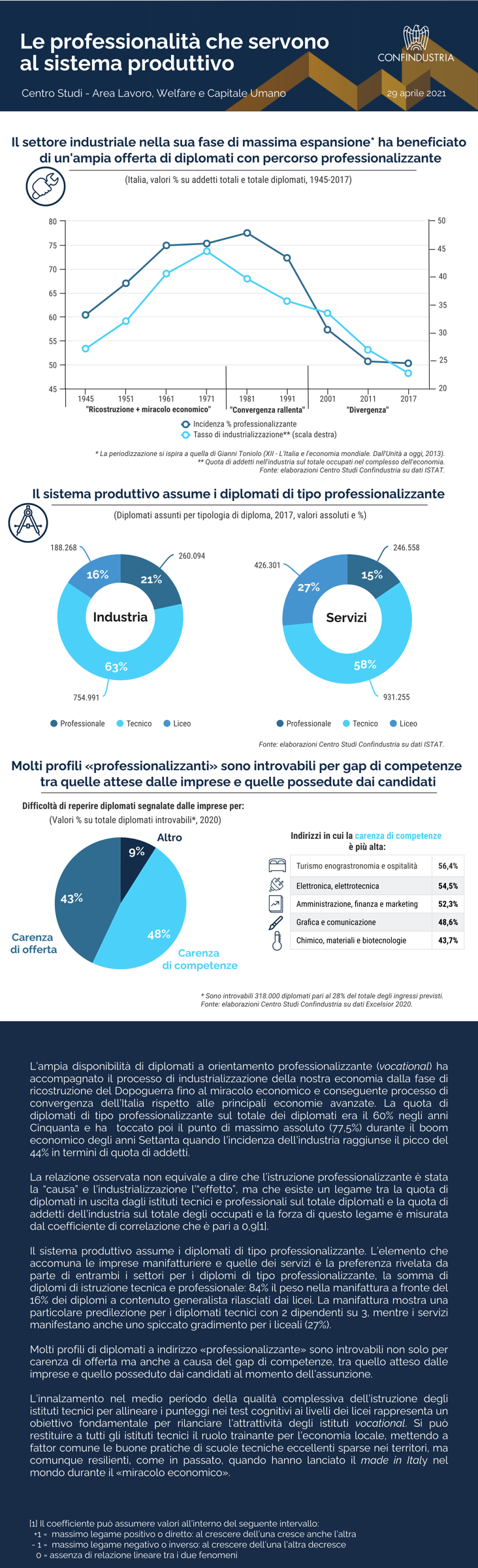
The wide availability of vocational graduates (vocational) accompanied the industrialisation process of our economy from the post-war reconstruction phase through to the economic miracle and the subsequent convergence of Italy with the main advanced economies. The share of vocational graduates out of the total number of graduates was 60% in the 1950s and reached its absolute peak (77.5%) during the economic boom of the 1970s, when the industrial sector reached a peak of 44% in terms of the share of employees.
The observed relationship does not imply that vocational education was the "cause" and industrialisation the "effect", but rather that there is a link between the share of graduates from technical and vocational institutes out of the total number of graduates and the share of industrial employees out of the total workforce; the strength of this link is measured by a correlation coefficient of 0.9
The production system recruits vocational graduates. The common element between manufacturing and service companies is the revealed preference of both sectors for vocational diplomas, which combine technical and vocational education: they account for 84% in manufacturing, compared to 16% for generalist diplomas issued by lyceums. Manufacturing shows a particular preference for technical graduates, who make up 2 out of 3 employees, while the service sector also shows a marked appreciation for lyceum graduates (27%).
Many vocational graduate profiles are impossible to find, not only due to a lack of supply but also because of a skills gap, between what is expected by companies and what candidates possess at the time of hiring.
Raising the overall quality of education in technical institutes in the medium term to align cognitive test scores with those of lyceums is a fundamental objective for reviving the attractiveness of vocational institutes. All technical institutes can be restored to their role as drivers of the local economy by pooling the best practices of excellent technical schools scattered across the regions, while remaining resilient, as they were in the past when they launched "Made in Italy" to the world during the "economic miracle".
The first infographic on vocational education can be found at the link below:How relevant is vocational education in Italy?
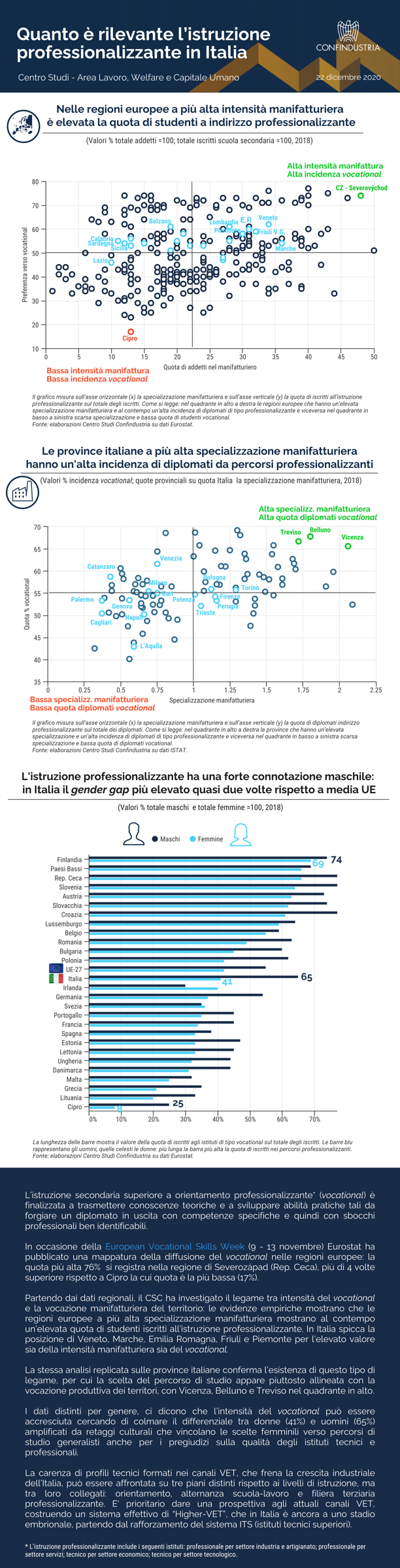
Upper secondary vocational education* is aimed at imparting theoretical knowledge and developing practical skills to produce graduates with specific competencies and, therefore, clearly identifiable career paths.
On the occasion of the European Vocational Skills Week (9 - 13 November), Eurostat published a map of the prevalence of vocational education in European regions: the highest share, 76%, is recorded in the Severozápad region (Czech Republic), more than four times higher than in Cyprus, which has the lowest share (17%).
Starting from regional data, the CSC investigated the link between the intensity of vocational education and the manufacturing vocation of the territory: empirical evidence shows that European regions with the highest manufacturing specialisation also have a high share of students enrolled in vocational education. In Italy, the position of Veneto, Marche, Emilia Romagna, Friuli and Piedmont stands out due to the high value of both manufacturing intensity and vocational education.
The same analysis replicated for Italian provinces confirms the existence of this type of link, whereby the choice of study path appears to be well-aligned with the productive vocation of the territories, with Vicenza, Belluno and Treviso in the top quadrant.
Gender-disaggregated data tell us that the intensity of vocational education can be increased by trying to bridge the gap between women (41%) and men (65%), which is amplified by cultural legacies that constrain female choices towards generalist study paths, partly due to prejudices regarding the quality of technical and vocational institutes.
The shortage of technical profiles trained in VET channels, which is holding back Italy's industrial growth, can be addressed on three distinct but interconnected levels of education: guidance, work-study programmes, and the vocational tertiary chain. It is a priority to provide a perspective for current VET channels by building an effective "Higher-VET" system, which is still in its embryonic stage in Italy, starting with the strengthening of the ITS (Higher Technical Institutes) system.
* Vocational education includes the following institutes: vocational for the industry and craft sector; vocational for the service sector; technical for the economic sector; technical for the technological sector.
News

News
News
News
News
subscribe to the EEN newsletter