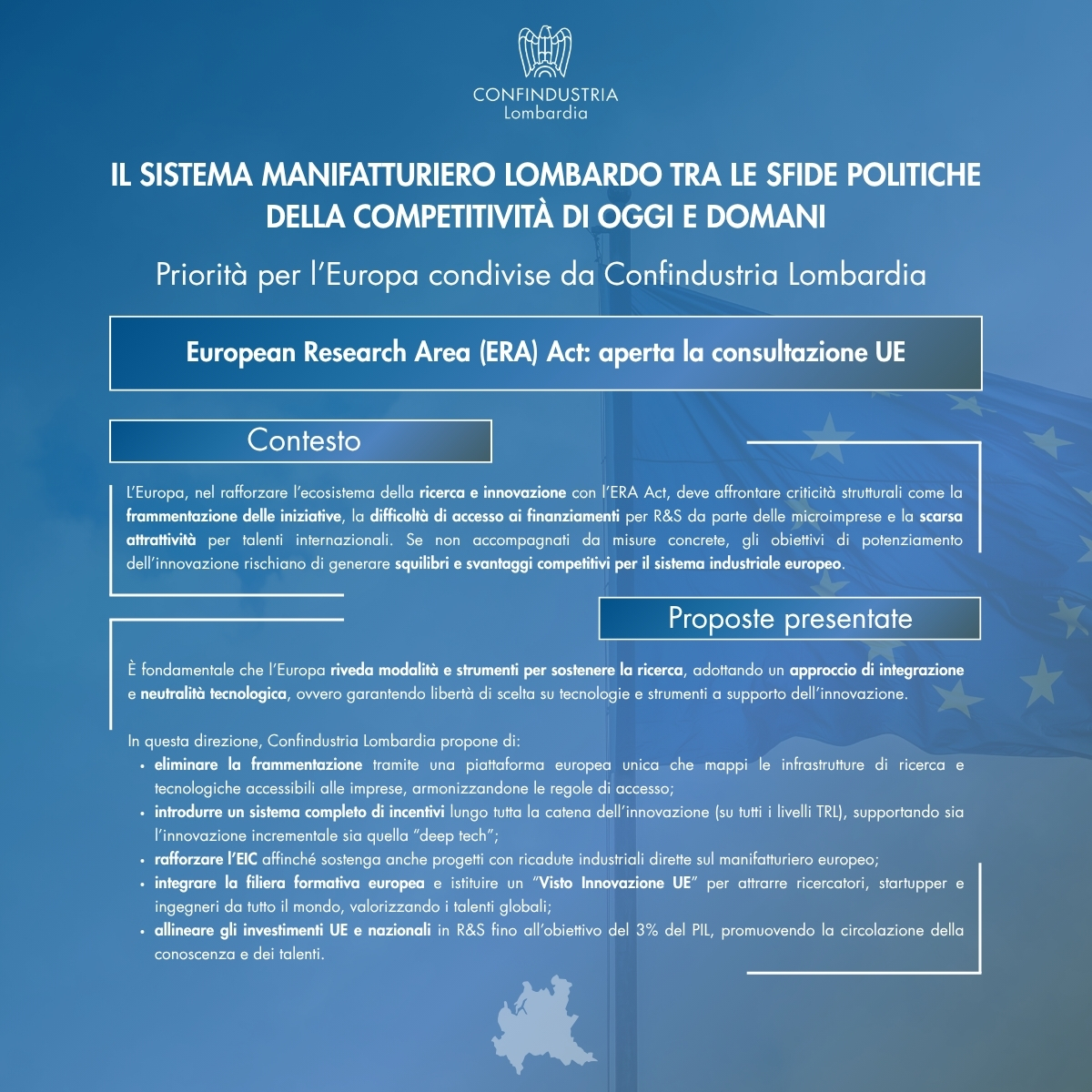
The public consultation on the European Research Area (ERA) Act is now underway, with the aim of strengthening the European research and innovation ecosystem by addressing the structural challenges that limit its full potential, including:
- The ongoing fragmentation of initiatives, which leads to the dispersal of resources and poor objective results.
- Difficulties in accessing R&D (Research and Development) funding, particularly for micro-enterprises.
- Difficulties in comparing qualifications obtained in Italy and/or the EU with non-EU qualifications, and a parallel lack of a visa strategy to facilitate the entry of students, skilled workers, and researchers into the EU.
The ERA Act aims to improve the overall environment for generating innovation, reduce fragmentation, and strengthen EU competitiveness, as well as boost research and development (R&D) investment to reach the target of 3% of GDP.
It will focus research support on strategic priorities, strengthen the alignment between EU and Member State funding priorities, and promote the free movement of knowledge and talent across Europe.
The initiative also complements the Choose Europe (2025–2027) programme, worth 500 million euros, which aims to attract and retain talented researchers and promote Europe as a hub of scientific excellence.
Confindustria Lombardia, in its document "Priorities for Europe shared by Confindustria Lombardia", proposes to:
- eliminate fragmentation by implementing a platform that maps European research and technological infrastructures accessible to businesses, while harmonising access rules.
- provide an organic and comprehensive set of incentive tools capable of supporting every stage of the innovation development chain, across all TRL levels.
Furthermore, it is necessary to ensure that the primary objective of the EIC (European Innovation Council) is to strengthen the European industrial and technological base. This must be achieved not only through purely "deep tech" innovations, but also by being open to incremental innovation, supporting projects with direct impacts on the manufacturing industrial system.
- Work on the integration of the education supply chain to enhance tertiary education at a European level. This must be achieved through the creation of a single European visa for researchers, start-uppers, and engineers, the "EU Innovation Visa", to attract global talent. It is also necessary to support businesses in the non-EU skills acquisition phase, by dedicating more resources to systemic projects that provide comprehensive support throughout the entire process.
The consultation will remain open until 5 January 2026; further information is available on the dedicated page.
To read and/or download the document: Priorities for Europe shared by Confindustria Lombardia