News

Circular economy: Council approves new rules to reduce marine litter

On 21 May, the EU Council adopted ambitious measures proposed by the Commission to address marine litter originating from the 10 single-use plastic products most frequently found on European beaches, as well as abandoned fishing gear and oxo-degradable plastic.

The rules regarding single-use plastic items and fishing gear provide for different measures to be applied to different products, placing the EU at the forefront of the global fight against marine litter. Where alternatives are readily available and affordable, single-use plastic products such as cutlery, plates, and straws will be banned from the market. For other product types, use will be limited by reducing national consumption, introducing design and labelling requirements, and imposing waste management and clean-up obligations on producers.

The new rules are proportionate and designed to achieve the best results, as different measures will apply to different products. The new rules introduce:

  • a ban on single-use plastic products for which alternatives exist on the market - cotton bud sticks, cutlery, plates, straws, drink stirrers, balloon sticks, as well as expanded polystyrene cups and food and beverage containers, and all oxo-degradable plastic products;
  • measures aimed at reducing the consumption of plastic food containers and beverage cups, and specific marking and labelling for certain products;
  • extended producer responsibility schemes covering the costs of waste clean-up, applied to products such as tobacco product filters and fishing gear;
  • a separate collection target for plastic bottles of 90% by 2029 (77% by 2025) and the introduction of design requirements to ensure that caps remain attached to bottles, as well as a target to incorporate 25% recycled plastic in PET bottles from 2025 and 30% in all plastic bottles from 2030.

Next steps:

The directive will enter into force 20 days after its publication in the Official Journal. Member States will have two years to transpose the legislation into their national law.

The directive has set different dates for the transposition of certain measures:

  • bans and labelling obligations must be implemented two years after entry into force;
  • the obligation to attach caps and lids to beverage containers of up to 3 litres must be transposed no later than five years after the directive enters into force.
  • Depending on the product, additional obligations regarding extended producer responsibility must be met between January 2023 and 31 December 2024.

For further information, click here: http://europa.eu/rapid/press-release_IP-19-2631_it.htm
News
Report: Human Resources Figures for Lombardy - 2026 Edition

News

Business and diplomacy in Lombardy: the Consular Corps roadshow

News

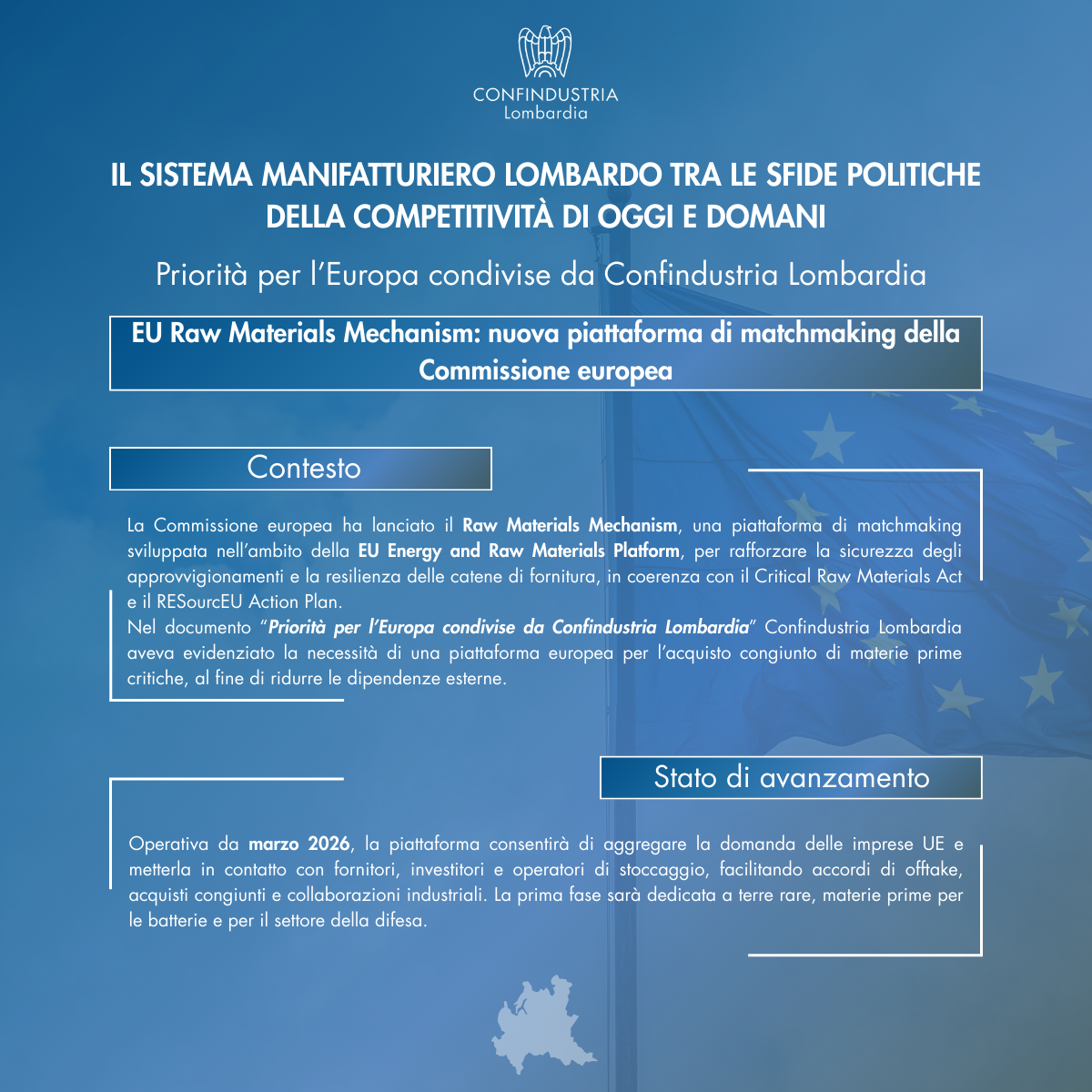
EU Raw Materials Mechanism: new European Commission matchmaking platform

News

Human Capital and Labour: training at the service of business competitiveness

News

Industrial Policies: credit, innovation, environment and energy for business competitiveness