

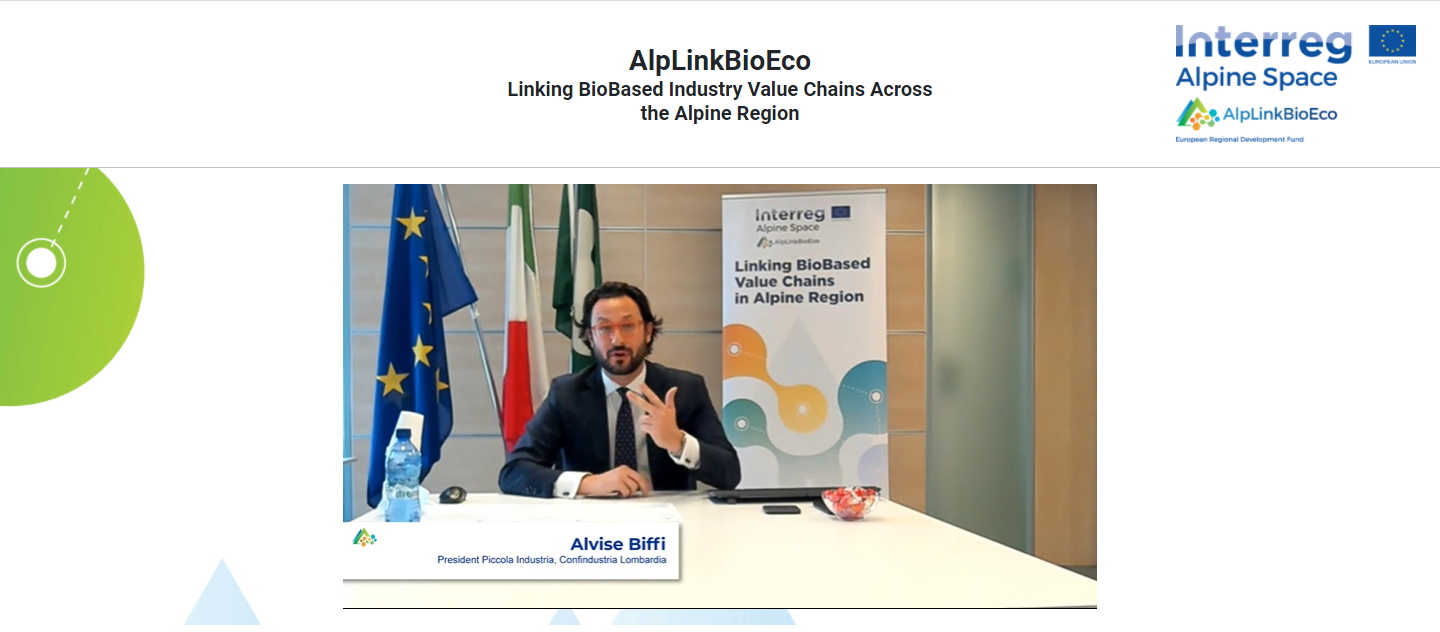
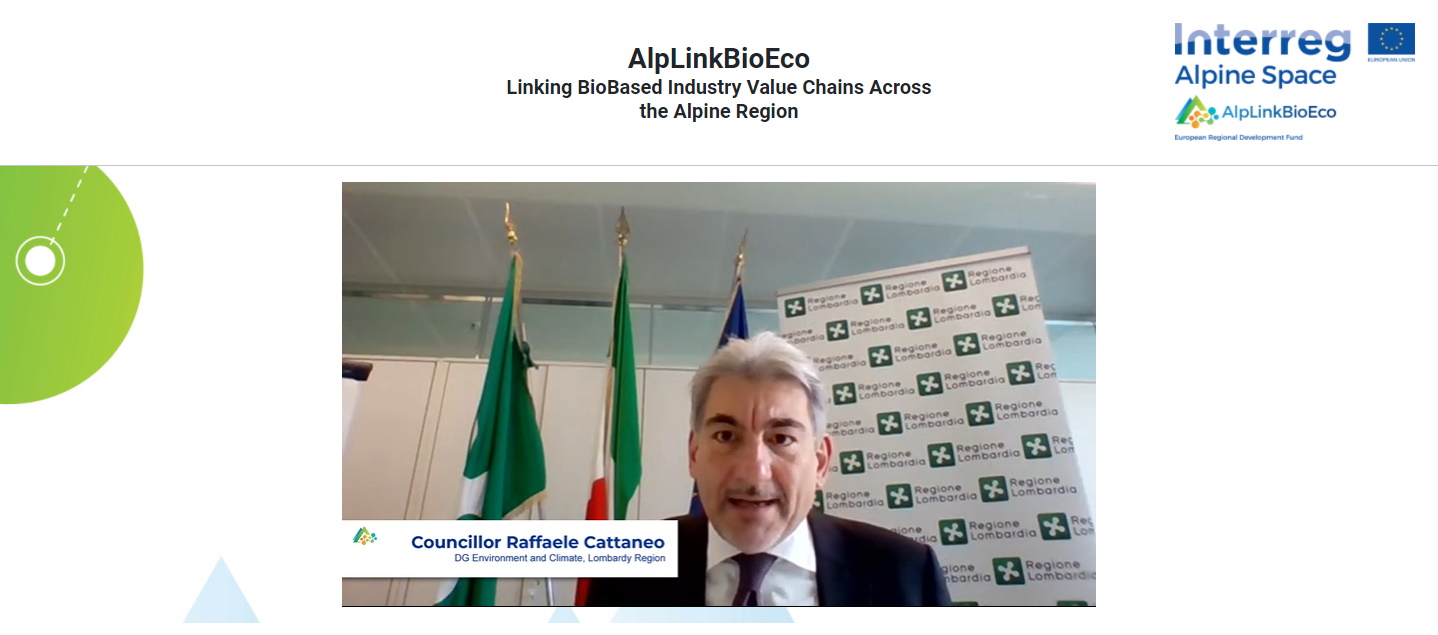
Milan, 31 March 2021 – The European Interreg project AlpLinkBioEco concluded today with an online conference. The project was launched three years ago as part of the EUSALP Alpine macro-regional strategy with the aim of developing interregional proposals to strengthen innovative supply chains operating in the circular bioeconomy sector. The event was attended by the President of the Small Industry division of Confindustria Lombardia, Alvise Biffi, and the Regional Minister for Environment and Climate of Lombardy, Raffaele Cattaneo.
Over the past three years, AlpLinkBioEco, in which Confindustria Lombardia is a partner, has focused on bioeconomy and circular economy issues, which are considered drivers of competitiveness, sources of added value for businesses, and fundamental components for achieving the goals of the European Green Deal and the United Nations Sustainable Development Goals.
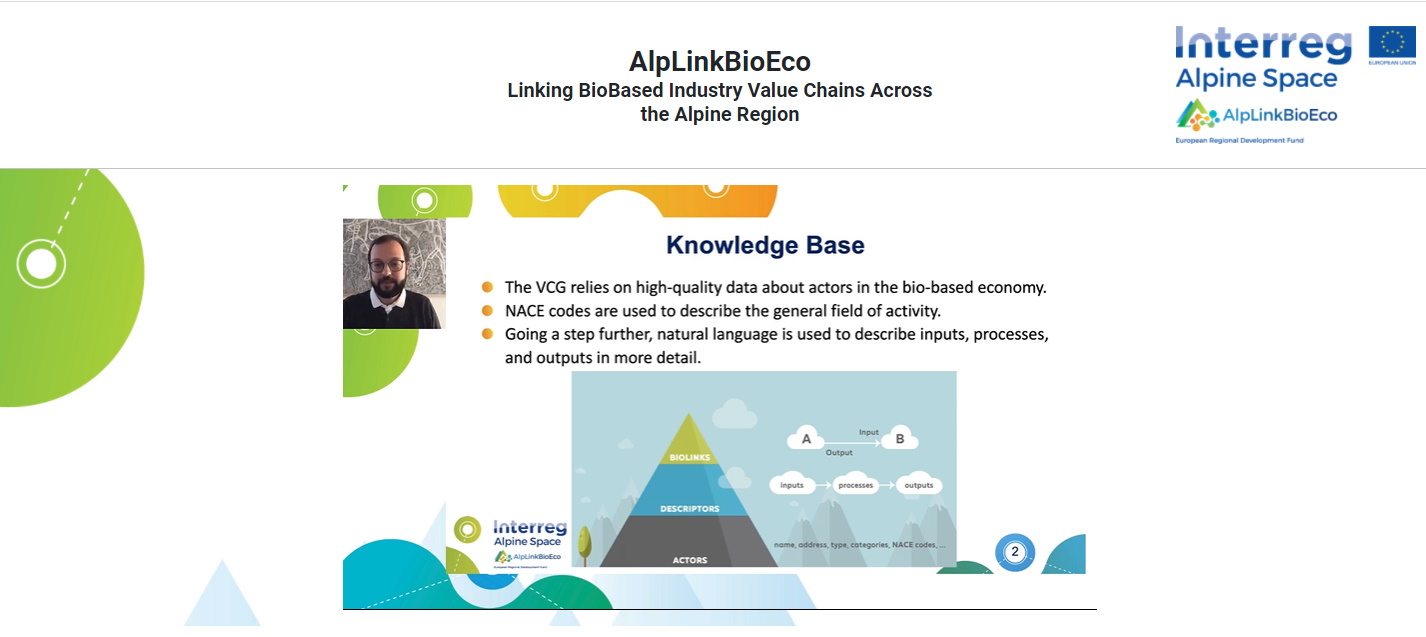
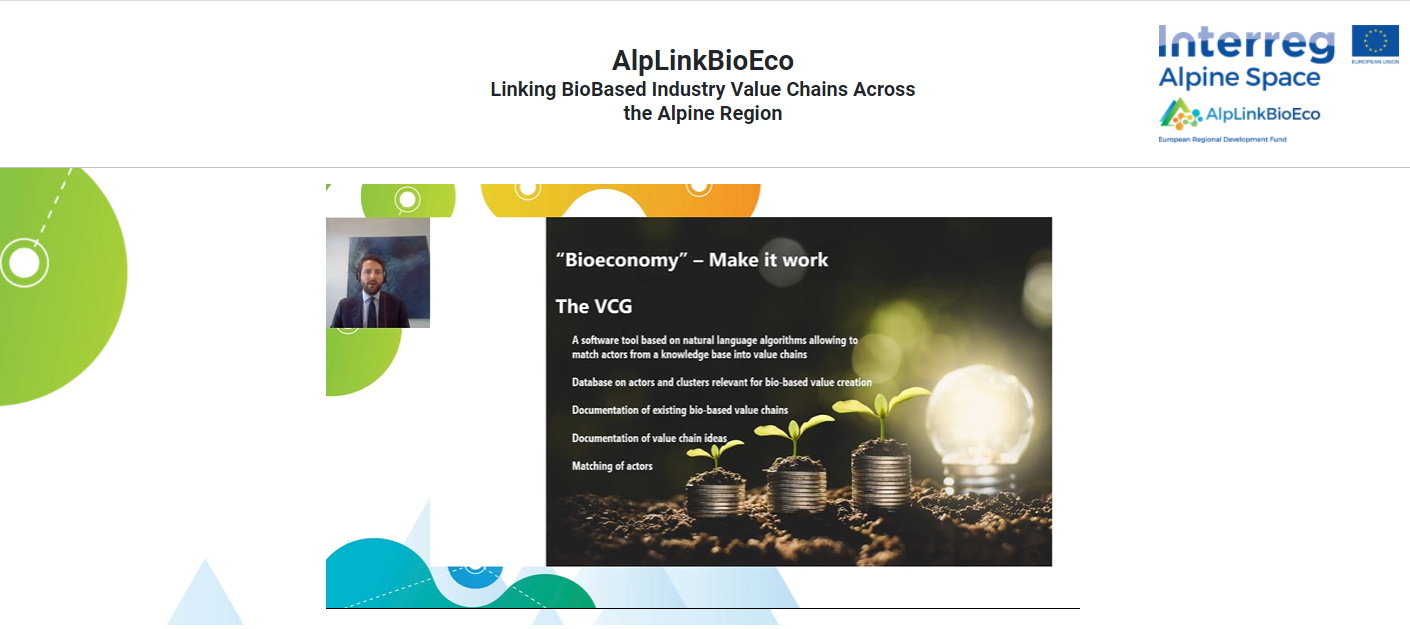
To support the transition from a fossil fuel-based economy to a bio-based economy, an interactive database, the Value Chain Generator, was developed at the start of the project. This involved mapping dozens of sector associations and hundreds of companies, subsequently developing new value chains and opportunities for industrial symbiosis at local, national, and transnational levels.
Furthermore, thanks to input gathered from political and industrial stakeholders across the European regions involved, a shared action plan (Masterplan) has been defined to stimulate the development of the bioeconomy in the Alpine Space.
“Projects like AlpLinkBioEco demonstrate that industry is the primary actor in the sustainable transition, and that innovative supply chains operating in the bioeconomy and circular economy sectors are fundamental elements of competitiveness. The crisis has taught us that the dynamism of local areas is essential and must be facilitated by leveraging the specificities of the context and building an interconnected system. In this framework, macro-regional projects fit into a context that is both homogeneous and complementary in terms of specialisation, creating the competitive conditions in which businesses operate, both in terms of production and resource valorisation, from a circular perspective. Businesses will certainly know how to seize the opportunities offered by the circular economy to grow and develop,” stated the President of Confindustria Lombardia, Marco Bonometti, “but to achieve this transition, clear and certain rules are urgently needed.”
“The challenge today is to integrate the bioeconomy and the circular economy: combining the circular model with a model that looks at the use of biological resources. The action taken by the Lombardy Region,” states the Regional Minister for Environment and Climate, Raffaele Cattaneo, “is moving in this direction. We are implementing policies that look towards sustainability, with a view to an alliance between businesses and the environment. The same must be done for the bioeconomy, which must be supported so that it develops actions that look towards the circular economy. Indeed, in Lombardy, there are more than 25,000 companies operating in the biochemical sector—over a fifth of the total in Italy—that make research and innovation their strength. They invest over 3 billion euros, and the number of employees in the sector reaches 33,000 (out of 50,000 in Italy). The role of the AlpLinkBioEco project is
fundamental because it has created value by supporting businesses in this challenge. All this within the framework of EUSALP, in which the Lombardy Region is a key player, and where the green economy and sustainability are at the heart of the policies of the Alpine Regions.”
The project involved the participation of 6 states in the Alpine region (Italy, France, Germany, Austria, Switzerland, and Slovenia) and 9 regions, 3 of which are part of the Four Motors for Europe (Lombardy, Baden-Württemberg, and Auvergne-Rhône-Alpes). Fourteen partners worked on the project:
Plastics Innovation Competence Center – Research Center (CH); Business Upper Austria – OÖ Wirtschaftsagentur Ltd. – Regional Public Authority (AT); Poly4EmI hosts by Anteja ECG d.o.o. – Business Support Organization (SI); University of Tuscia – CSALP – University (IT);
Confindustria Lombardia – Business Support Organization (IT - Lombardy); BIOPRO Baden-Württemberg GmbH – NGO (DE – Baden-Württemberg); Hub Innovazione Trentino – Business Support Organization (IT - Trentino); Technology Center Horb GmbH&Co.KG – Business Support Organization (DE - Stuttgart); Lombardy Green Chemistry Association – Cluster (IT Lombardy); Plastipolis – Business Support Organization (FR - Auvergne-Rhône-Alpes); France Clusters – Business Support Organization (FR - Auvergne-Rhône-Alpes); Ministry of Education, Science and Sport – Public Administration (SI); Chemie Cluster Bavaria – Cluster (DE - Bavaria); Fraunhofer Italia – Non-profit research Organization (IT – South Tyrol).
In addition to the Lombardy Region, the project also saw the participation of the regional cluster LE2C as an observer.
News
News
News
News
News
subscribe to the EEN newsletter