
Date:
23 October 2026
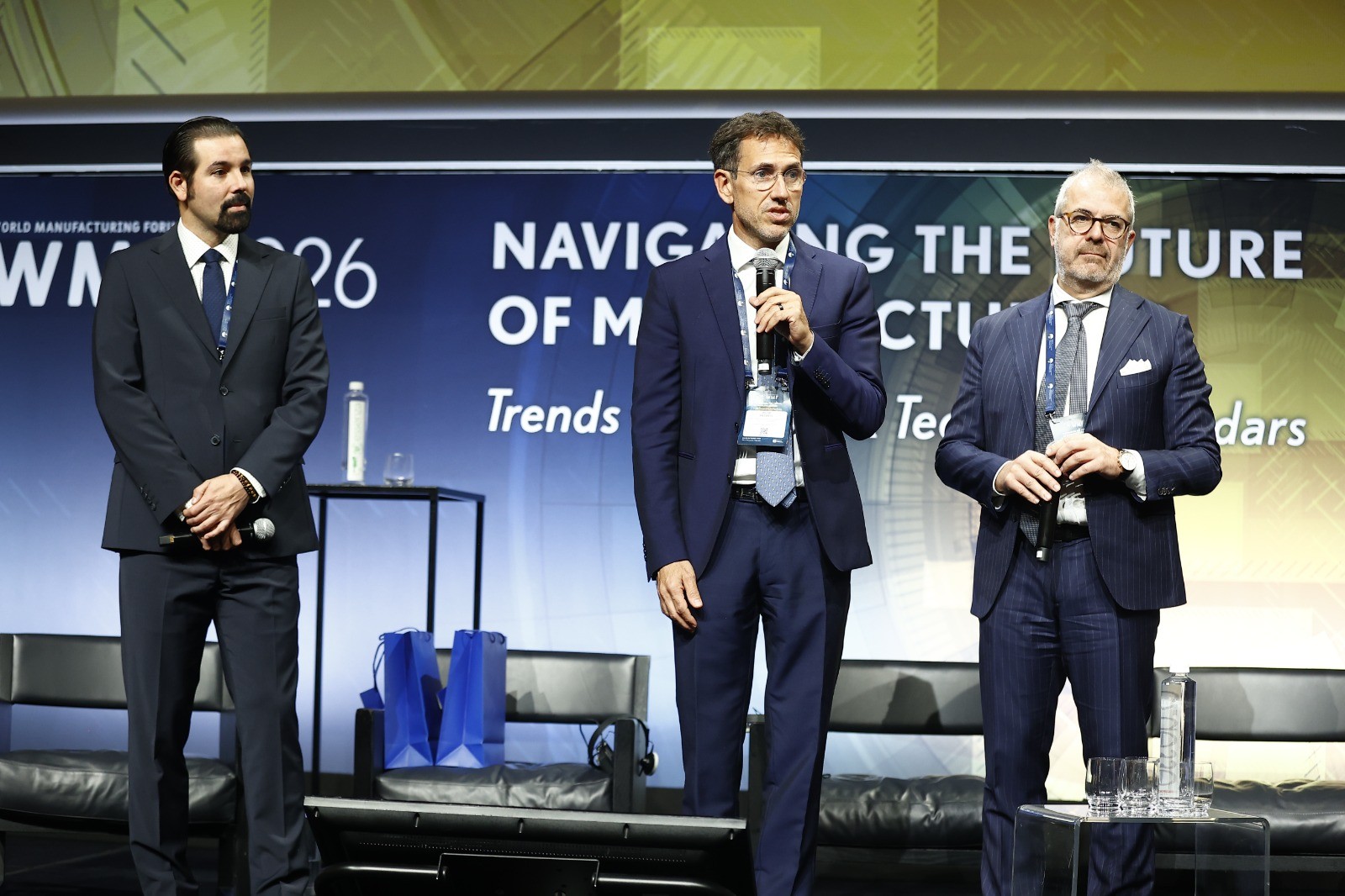
Milan, 23 October 2026 – The 14th edition of the World Manufacturing Forum concluded in Milan today. The international event, promoted by the World Manufacturing Foundation, was titled "Navigating the Future of Manufacturing: Trends Compass & Technology Radars". Over the two days at Palazzo Mezzanotte, the Forum recorded over 1,200 attendees from businesses, institutions, universities, and international organisations, representing 48 countries, in a discussion dedicated to the technical and strategic themes currently reshaping global industry.
OPENING WITH WOMEN AT THE HELM OF MANUFACTURING: proceedings opened with a special address by the SPRI Group, "Women at the Manufacturing Helm: Leadership for Growth and Prosperity", delivered by Cristina Oyón, Director of Technology, Innovation and Sustainability at the SPRI Group (Spain). Since 2020, the SPRI Group and the World Manufacturing Foundation, alongside the Women in Manufacturing expert group, have been promoting global dialogue and action for greater participation, leadership, and inclusion of women in manufacturing sectors. The address reviewed progress, challenges, and new opportunities to strengthen gender diversity in a sector undergoing significant technological and organisational transformation, reiterating the value of diverse talent for innovation, resilience, and competitiveness, and presenting recommendations to accelerate women's growth and leadership in global manufacturing.
A GLOBAL PERSPECTIVE: subsequent special addresses broadened the scope. Duck Young Kim, Director of the Factory Intelligence Laboratory at POSTECH (South Korea), illustrated manufacturing innovation trends in South Korea and East Asia, where Industry 4.0 and 5.0 technologies, sustainability, and human-centric production systems are advancing in tandem. Rafik Feki, UNIDO representative and President of the Alliance for Industry 4.0 and Smart Manufacturing in Africa (AISMA), presented the African continent's potential as the next frontier for smart manufacturing, supported by a continental market of over 1.3 billion people created by the AfCFTA.
FOCUS ON PEOPLE: the panel dedicated to skills, featuring Johan Stahre (Chalmers University of Technology, Sweden), addressed the anticipation of technological changes and strategies for reskilling and upskilling, aiming for pathways that are inclusive and accessible to all regions, generations, and demographics. The discussion on wearable devices and human-centric technologies, with Malgorzata Koszalkowska (Volvo Group, Sweden), highlighted smart glasses, exoskeletons, biometric sensors, and augmented reality as tools to enhance worker productivity, safety, and well-being.
FOCUS ON DATA AND ARTIFICIAL INTELLIGENCE: the panel on industrial data analysis, digital twins, and simulation, featuring Dominik Rohrmus (Siemens and Labs Network Industrie 4.0, Germany) and John Dyck (CESMII, USA), explored the shift towards proactive operations management. The debate on agentic AI, with Evgeny Kharlamov (Bosch Center for Artificial Intelligence, Germany) and Jeff Winter (Belden, USA), addressed the role of autonomous agents transitioning from support tools to active drivers of value creation. The panel on Physical AI and humanoid robotics, with Noriko Suzuki (IBM Institute for Business Value, Japan), discussed applications in logistics, assembly, inspection, and maintenance, as well as the future of human-robot collaboration.
INDUSTRIAL POLICIES: the panel "Industrial Policy for Future-Ready Manufacturing Value Chains", supported by the Lombardy Region, brought together institutions, businesses, and international organisations from Lombardy, Catalonia, Bavaria, and Germany. The focus was on the competitiveness of European manufacturing, squeezed between high energy costs, increasing regulatory burdens, and ever-more aggressive competition. Discussions covered which policy changes could truly make a difference and where the EU must correct its course, rather than simply asking businesses to adapt to static rules. The session also addressed growth, exploring how to transform employment and economic development into productivity and investment, as well as strategic autonomy regarding the choice of which technologies to retain in Europe.
CLOSING: the day concluded with the signing ceremony for memoranda of understanding between the World Manufacturing Foundation and its partners, followed by closing remarks from Diego Andreis, Marco Taisch, and David Romero.
Guido Guidesi, Regional Minister for Economic Development, Lombardy Region: "The World Manufacturing Forum is a fundamental event for sharing experiences, discussing technological transformations, and building the future of manufacturing together. Our companies have proven their ability to innovate, invest, and compete, but we cannot continue to ask them to face global challenges with rules that penalise them compared to international competitors. Europe must change its approach, prioritise industrial competitiveness, and ensure technological neutrality. As Lombardy, we have chosen to build alliances with other major European manufacturing regions to present a unified voice in decision-making bodies. Our dialogue with Bavaria and Catalonia is aimed precisely at this: starting from the concrete needs of productive territories to help change European policies. Because without a strong industry, there is no work, growth, or future."
Giuseppe Pasini, President, Confindustria Lombardia: "In a complex phase like the current one, collaboration between regions and similar production systems is essential for Confindustria Lombardia. For this reason, the discussion held today at the WMF during the 'Industrial Policy for Future-Ready Manufacturing Value Chains' panel—involving the Region, Confindustria Lombardia, and representatives from Spanish and German institutions and businesses—is an important signal for the further integration of production chains, as well as for building critical mass to address common challenges and priorities in a coordinated manner."
Diego Andreis, President, World Manufacturing Foundation: "With 48 nationalities represented, over 1,200 total attendees across the two days—62% of whom were from the business sector—and 50 international speakers, the Forum confirms the value of a discussion capable of uniting diverse skills and perspectives to interpret technological transformations and guide the choices of businesses and countries in such a strategic sector for the future. We look forward to the fifteenth edition in 2027, with the ambition to further expand this dialogue and bring the visions of the world's leading innovation figures in manufacturing to the Forum."
Marco Taisch, Scientific Chairman, World Manufacturing Foundation: "Industrial development is an investment in peace. If there is industrial development, there is work. If there is work, there is well-being and peace of mind. If there is well-being and peace of mind, the conditions exist for peace to endure. I believe this is the great message emerging from WMF 2026: the awareness that the development of manufacturing is not only an engine of economic growth and technological progress, but can also be an extraordinary tool for diplomacy, cooperation, and peacebuilding. Industry does not merely produce goods, technologies, and economic value; it produces opportunities, generates skills, restores prospects to people, and contributes to building more solid and resilient communities. Through industry, we create decent work, foster confidence in the future, social inclusion, and stability. Through industry, people can build their own tomorrow, reducing the conditions of uncertainty that too often fuel conflict. It is from this perspective that an event like the WMF goes beyond the boundaries of economics and academic research: it becomes a lever for dialogue between countries, a ground on which to build shared interests, and a collective responsibility towards future generations. This is the mission of the Forum."
subscribe to the EEN newsletter