
.jpg)
Data:
23 March 2026
Categoria:
Territorial Policies
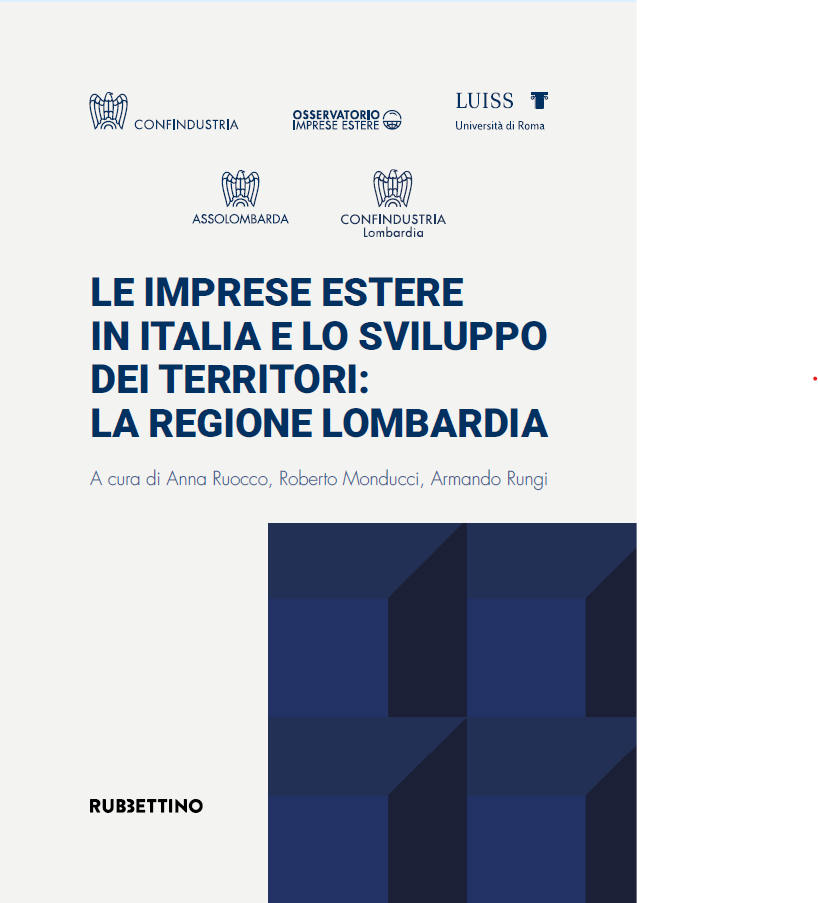
This research provides a comprehensive and well-documented overview of the structure, dynamics, and role of foreign companies in the Lombardy region. The study integrates quantitative analysis with microeconomic insights, leveraging both official ISTAT statistical sources and specialised databases, which are noted for their high quality and informative capacity.
The objective is to present a detailed information framework at both sectoral and provincial levels, offering various interpretations regarding the role and characteristics of foreign companies in the region, while also developing original analyses on several aspects critical to the region's competitiveness.
Significant emphasis is placed on the comparative analysis of foreign-controlled versus domestic-controlled companies in Lombardy, and of Lombardy within the broader context of European regions. The report also examines R&D investment by foreign companies in the Lombardy territory, their intangible capital assets, and patent activity.
According to the Report:
there were 20,234 local units operating in the Lombardy region in 2023;
they generate 37.9% of the total value added produced in the country by this type of company;
and 25.1% of the total regional value added;
38.6% of R&D expenditure by Lombard companies (totalling 4.33 billion euros) is attributable to foreign-owned companies;
R&D expenditure per employee in foreign companies is very high, approaching 95,000 euros;
30.1% of researchers active in Lombardy are employed at the sites of foreign companies;
there are 10 sectors—both manufacturing (pharmaceuticals, electrical equipment, electronics and measuring instruments, chemicals, rubber and plastics, mining) and services (trade, ICT services, professional, scientific and technical activities, business services)—in which the presence of foreign multinationals is particularly distinctive, characterised by high regional attractiveness and strong specialisation. Together, these sectors account for 49.8 billion in value added and 409,000 employees, with labour productivity levels significantly above the regional average;
at a territorial level, the Metropolitan City of Milan hosts 11,430 local units of foreign companies, equivalent to 56.5% of the Lombard total, which generate 70.4% of the regional value added by foreign companies;
foreign companies in Lombardy hold more patents on average than domestic ones (24 compared to 10) and are characterised by technological diversification and the quality of the knowledge generated. In 83.2% of cases, patent collaborations with other companies involve foreign entities, while 25.2% of collaborations are with small and medium-sized enterprises;
compared to German benchmarks, the share of foreign manufacturing companies in high-tech sectors in Lombardy stands at 11.3%, against 18.0% in Bavaria and 15.7% in Baden-Württemberg;
compared to European benchmarks, Lombardy confirms its strength: Lombard foreign manufacturing companies rank second in terms of productivity, behind foreign multinationals located in Auvergne-Rhône-Alpes, but ahead of those in Catalonia, Baden-Württemberg, and Bavaria;
in an international comparison, the positioning of Lombard foreign companies in the service sector, with 46% operating in knowledge-intensive services, is second only to that recorded in Bavaria (48%).
The Report is the result of a collaboration between Confindustria (Foreign Companies Observatory), Confindustria Lombardia, and Assolombarda, with the involvement of other territorial associations that are members of Confindustria Lombardia: Associazione Industriali Cremona, Confindustria Alto Milanese, Confindustria Bergamo, Confindustria Brescia, Confindustria Como, Confindustria Lecco e Sondrio, Confindustria Mantova, and Confindustria Varese.
Attached are the full Report and the slides presented by Matteo Laffi and Armando Rungi during the launch event.

subscribe to the EEN newsletter