

Date:
22 July 2016
Alberto Ribolla: now is the time to reduce the supply-demand gap and focus on school-work placement
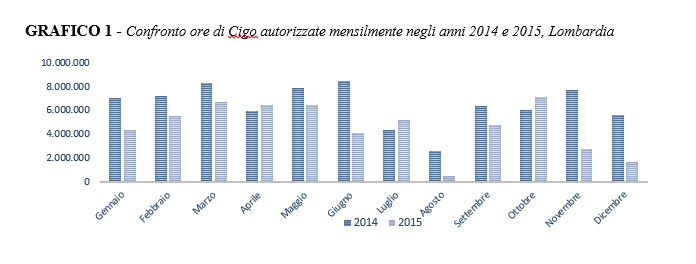
Milan, 22 July 2016 – The Lombardy labour market has suffered the effects of the long crisis but, despite this, shows remarkable resilience and vitality. The 9th edition of the study 'The Labour Market in Lombardy' by Confindustria Lombardia highlights a context for 2015 that has regained dynamism in terms of inflows, with the unemployment rate falling for the first time in 7 years (7.9%), a positive employment balance compared to 2014 (+128,000 units) and a collapse in the use of the Wage Guarantee Fund (CIG) (-38% compared to the previous year – chart 1).
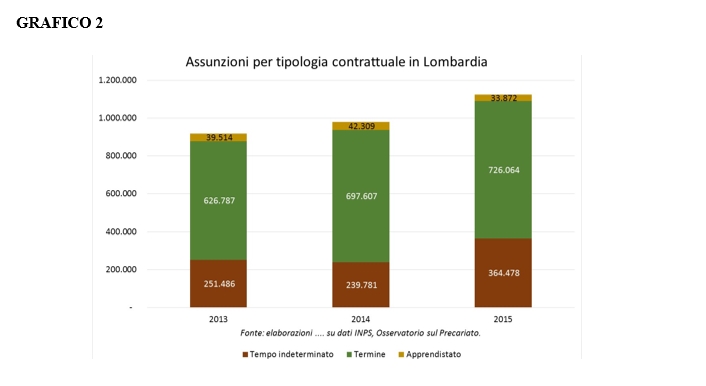
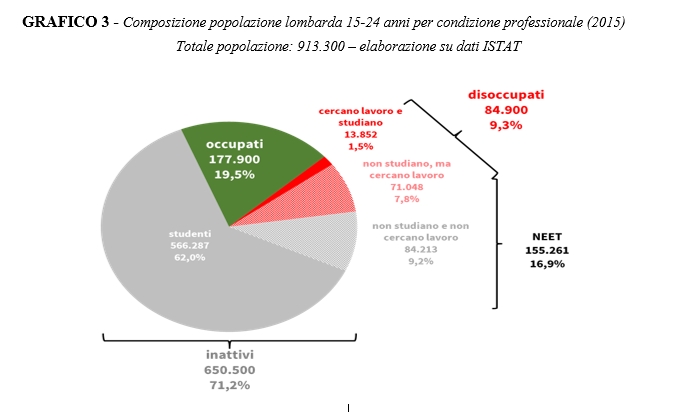
Furthermore, in 2015, total recruitment in Lombardy amounted to 1.1 million, almost 145,000 more than in 2014 (+14.8%): permanent contracts accounted for 364,000 (+52.0% on 2014), bucking the trend seen in 2014 (-4.7% on 2013 - chart 2). Youth unemployment is alarming: in Lombardy, young people between 15 and 24 living on the margins of the labour market number nearly 170,000 (over 155,000 NEETs and 14,000 unemployed individuals engaged in training courses), more than 18% of this age group (chart 3).
“The Confindustria Lombardia report reveals a strong entrepreneurial fabric, capable of withstanding years of crisis and reacting to external shocks, with a high level of responsibility from both entrepreneurs and the workforce in managing time and resources. However, we must work to further reduce the absence rate, just as we are doing with accident prevention, which has fallen by 4% compared to 2014 and by 36% over the last 5 years. All these elements influence our unit labour costs and therefore the competitiveness of our companies. Of course, returning to pre-crisis employment levels will not be simple, but Lombard companies have the resources to overcome this challenge, as demonstrated by the positive employment balance, the unemployment rate at European levels, and the responsiveness in seizing opportunities represented by measures such as social security contribution relief and the Jobs Act,” declares the President of Confindustria Lombardia Alberto Ribolla.
“The 2015 data – adds Ribolla – represent a good starting point for refining a more mature regional labour market, in which supply and demand are less unbalanced and where the number of those excluded is reduced. Bringing NEETs and women into the world of work and further absorbing the CIG means reducing the gap between labour supply and demand. These are objectives that the Confindustria Lombardia system intends to pursue by identifying the needs of Lombard companies and the evolutionary dynamics of the labour market, and by promoting school-work placement, also thanks to synergies with institutions and other regional stakeholders,” concludes Alberto Ribolla.
The 2016 report, prepared by the Confindustria Lombardia Research Centre based on 2015 Istat data and a questionnaire completed by approximately 1,000 Lombard companies, then focuses on working hours and absences from work:
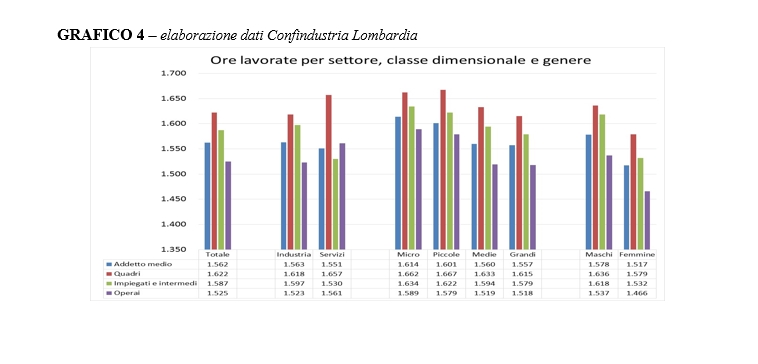
- workable hours (averaging 1,659 in 2015) and hours worked (1,562) increase with job qualification and are inversely correlated to company size (chart 4);
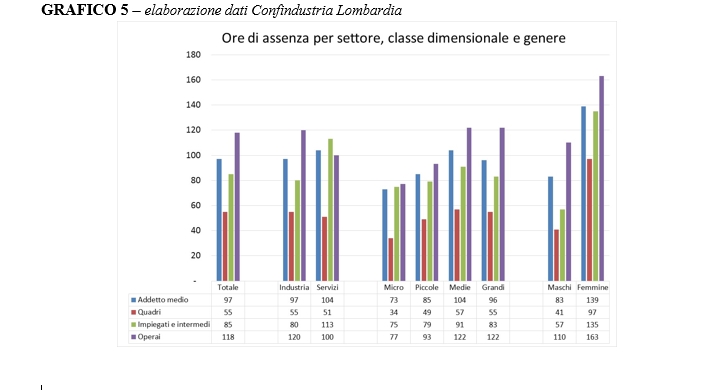
- hours of absence in Lombard companies averaged 97, with micro-enterprises recording the lowest number: a phenomenon that is not surprising, linked to the greater sense of belonging of the employee that arises from the smaller hierarchical distance and the direct relationship with the employer (chart 5);
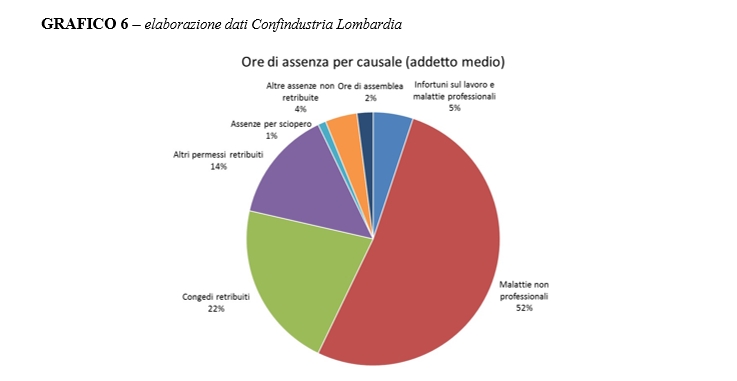
- the composition of hours of absence by cause shows, even in 2015, a clear prevalence of non-occupational illnesses (52%), with paid leave accounting for 22%, other paid leave for 14%, and workplace accidents for 5%. Strikes and meetings account for a total of 3% (chart 6);
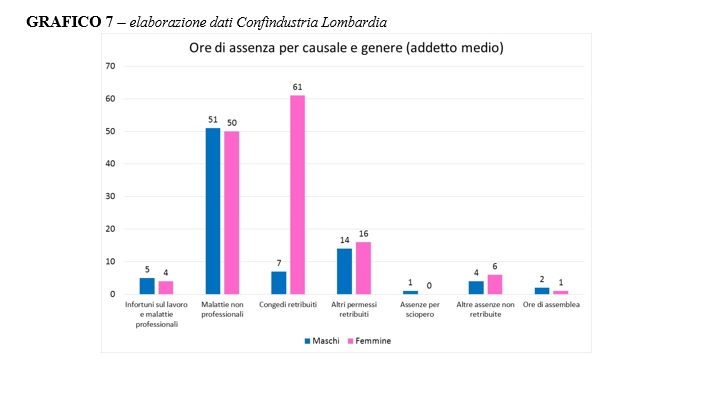
- absence rates are higher for women (8.4%) than for men (5%): a differential almost entirely due to the use of parental leave, a predominantly female cause (chart 7);
- one in four companies made use of the CIG. CIG diffusion at 23% (26% industry, 3% services); CIG incidence at 1.7% of workable hours;
- four out of five companies made use of overtime. Overtime diffusion at 82%; overtime incidence at 3.5% of workable hours (a function of job classification and gender). In summary, overtime accounts for twice as much as the CIG of total hours worked (3.5% vs 1.7%).
Attached is the complete 'The Labour Market in Lombardy – 2016 Report'
subscribe to the EEN newsletter